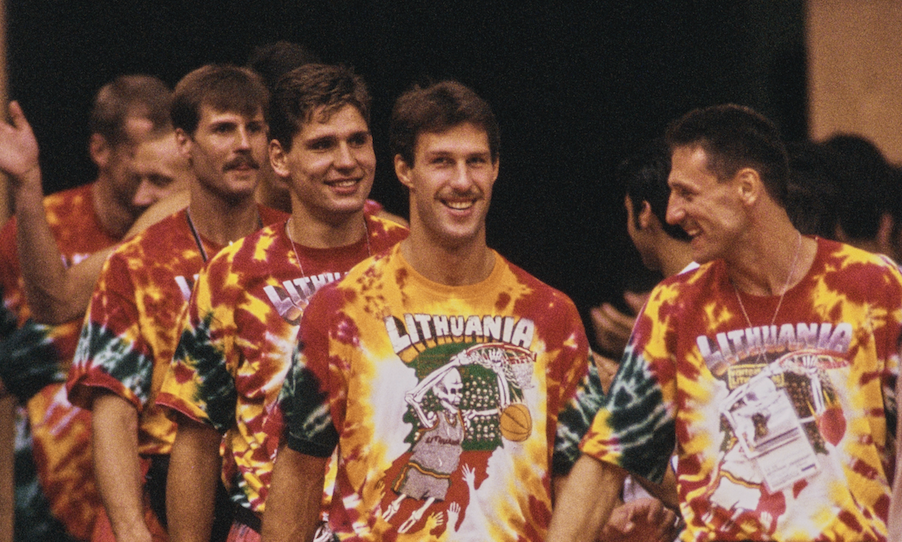
At the 1992 Olympics in Barcelona, a unique rivalry unfolded alongside the iconic “Dream Team” from the United States. While Michael Jordan and his teammates captivated audiences with their unmatched talent, another team emerged as heroes in their own right: the Lithuanian national basketball team. Their journey, fueled by a spirit of independence, transcended sports and highlighted a nation’s struggle for identity.
The Rise of the Dream Team
In the 1988 Olympic Games held in Seoul, the USA men’s basketball team secured a bronze medal—a disappointing performance that marked their worst finish in Olympic history up to that time. Among the players was David Robinson, who would later earn the nickname “The Admiral” after graduating from the United States Naval Academy. Notably, all members of the 1988 team were still enrolled at the academy, as professional athletes were not permitted to compete in the Olympics at that time.
A significant shift occurred in 1989 when the Fédération Internationale de Basketball (FIBA) amended its rules, allowing NBA players to participate in Olympic basketball. This change paved the way for the legendary “Dream Team” at the 1992 Summer Olympics in Barcelona, widely regarded as the greatest collection of basketball talent ever assembled, featuring stars such as:
- Charles Barkley
- Larry Bird
- Clyde Drexler
- Patrick Ewing
- Magic Johnson
- Michael Jordan
- Karl Malone
- Chris Mullin
- Scottie Pippen
- David Robinson
- John Stockton
- Christian Laettner
The team’s dominance was overwhelming, as they defeated opponents with astonishing ease; their first-round match against Angola ended with a score of 116-48. Ultimately, the Dream Team clinched gold, with Croatia earning silver. However, an alternate story was unfolding in Barcelona.
The Other Dream Team
The early 1990s were marked by significant geopolitical change, as evidenced by the fall of the Berlin Wall in 1989 and Lithuania’s declaration of independence from the Soviet Union in March 1990. This newfound freedom was a triumph over decades of Soviet oppression, which included mass deportations and efforts to erase Lithuania’s cultural identity.
As the 1992 Summer Olympics approached, many new nations awaited their chance to compete on the world stage. However, the transition to independence came with challenges; newly liberated Lithuania faced an economic crisis, prioritizing essential services over sports. Amid this struggle, Sarunas Marciulionis, Lithuania’s most prominent NBA player and a pioneer in bringing Soviet talent to the league, sought to lead a national team to the Olympics.
Facing insurmountable travel and logistical costs, Marciulionis reached out for support. A local sports writer’s coverage of their plight eventually caught the attention of Dennis McNally, a publicist for the Grateful Dead, leading to a remarkable partnership.
The Rex Foundation’s Support
The Grateful Dead, through their charitable organization, the Rex Foundation, had a history of supporting various causes. Despite their usual focus on more traditional philanthropic activities, band members Bob Weir and Mickey Hart quickly recognized the significance of aiding Lithuania’s basketball journey. Weir later recounted the decision:
“Helping a group of Lithuanians attend a basketball tournament wasn’t exactly in our wheelhouse… but it represented a spirit of national identity and pride.”
The Rex Foundation donated $5,000 for travel expenses and collaborated to create tie-dye uniforms emblazoned with a “slam-dunking skeleton,” symbolizing freedom to the Lithuanian athletes. This vibrant attire contrasted sharply with the drab uniforms of the Soviet era.
The Lithuanian team became a source of excitement and national pride during the Olympics, captiving fans with their colorful uniforms and their spirit. As they prepared for the Bronze Medal match against the Unified Team—comprised of former Soviet republics—Marciulionis and his teammates viewed it as more than just a game; it was a display of peaceful resistance. Lithuania triumphed, winning a medal that held profound significance, transcending the mere achievement of a third-place finish.
A Lasting Legacy
The medal ceremony became a memorable moment in Olympic history when the Lithuanian team took to the podium clad in their vibrant Grateful Dead uniforms, defying pressure from Adidas to conform to standard attire. Their colorful presence stood in stark contrast to the Dream Team, leaving an indelible impression on the audience.
The image of the Lithuanian players adorned in tie-dye not only captured the spirit of the time but also sparked a fundraising initiative. Upon their return, the demand for the “slam-dunking skeleton” shirts surged, ultimately raising over $500,000 for Lithuanian children’s charities and schools. By the time of the 1996 Olympics in Atlanta, their partnership with the Grateful Dead continued to flourish, with the band’s logo incorporated into the team’s gear.
Today, the 1992 Bronze Medal win is recognized as a pivotal moment in sports history, celebrated in the documentary “The Other Dream Team.” It symbolizes a journey of resilience, identity, and the enduring spirit of a nation, reminding us that true victories can transcend medals, capturing the essence of human determination and connection.
Meet William, a proud Bethel University alumnus with a fervent passion for lifestyle and culture topics. His keen interest doesn’t stop there; he’s also deeply engrossed in current events of all kinds. William dedicates himself wholeheartedly to this site, thriving on the collaborative energy he shares with Suzanne, his long-standing partner in crime.
Having navigated their university courses side by side for years, their teamwork on the site is nothing short of dynamic. Together, they bring a unique blend of insights, proving that two heads are indeed better than one in delivering compelling content.