In a recent attack on the Hyperliquid platform, a sophisticated manipulation of the POPCAT token has led to substantial losses amounting to $5 million. As the market reacts, the price of the HYPE token remains under pressure, with notable declines in open interest for futures contracts.
POPCAT Attack Results in $5 Million Loss for HLP
The POPCAT attack unfolded on November 12, where a trader executed a series of manipulative transactions affecting the POPCAT token market by creating an artificial buying wall across multiple wallets.
According to on-chain analysts, approximately $3 million in USDC was deployed from the OKX exchange and distributed across 19 different addresses.
These wallets subsequently opened leveraged long positions totaling nearly $30 million, inflating the price of POPCAT to over $0.21. When the buying wall collapsed, the price plummeted, resulting in massive liquidations.
The Hyperliquid Provider (HLP) market-making system was thus forced to absorb these resultant positions due to the market’s low liquidity.
Overall, HLP incurred losses estimated between $4.9 million to $5 million.
The remaining long positions were passed to the Hyperliquidity Provider (HLP) to liquidate.
HLP appears to have lost $4.95M closing out the positions. pic.twitter.com/Qfq9jcy4Mz
— Arkham (@arkham) November 12, 2025
During the crash, the price of POPCAT fell from $0.21 to $0.13, forcing Hyperliquid to manually close its positions to mitigate further financial damage.
This incident highlights how coordinated movements of substantial capital across multiple wallets can destabilize decentralized platforms. Historical manipulative behaviors associated with tokens like TST, ZEREBRO, JELLYJELLY, and HIFI are reminiscent of the tactics used in this latest attack, though Hyperliquid stated that deposits and withdrawals have since been restored and normal trading has resumed.
Implications for Hyperliquid and DeFi Markets
The POPCAT attack underscores the enduring risks faced by decentralized exchanges that handle leveraged tokens.
Even though HLP managed to absorb the losses and protect liquidity providers, this event illustrates how thin liquidity and concentrated positions can amplify the effects of market manipulation.
Some analysts on Crypto Twitter have posited that such attacks may not always be profit-driven but could also aim to undermine the credibility of decentralized platforms.
Forensic analyses have examined the connections between the wallets involved in the manipulation and entities like BTX Capital, though these allegations remain unproven.
Hyperliquid’s response, which included a temporary pause on its Arbitrum bridge, has helped to stabilize the situation.
Nonetheless, the incident is likely to dampen investor sentiment, particularly as retail demand for HYPE has remained low following a significant decline in open futures interest over the past month.
Open interest for HYPE futures has also contracted, dropping from $2.08 billion at the end of October to $1.56 billion, indicating reduced risk appetite among traders.
HYPE Price Reaction Following the Attack
Despite the substantial loss, the HYPE token has demonstrated a degree of resilience in the aftermath of the attack.
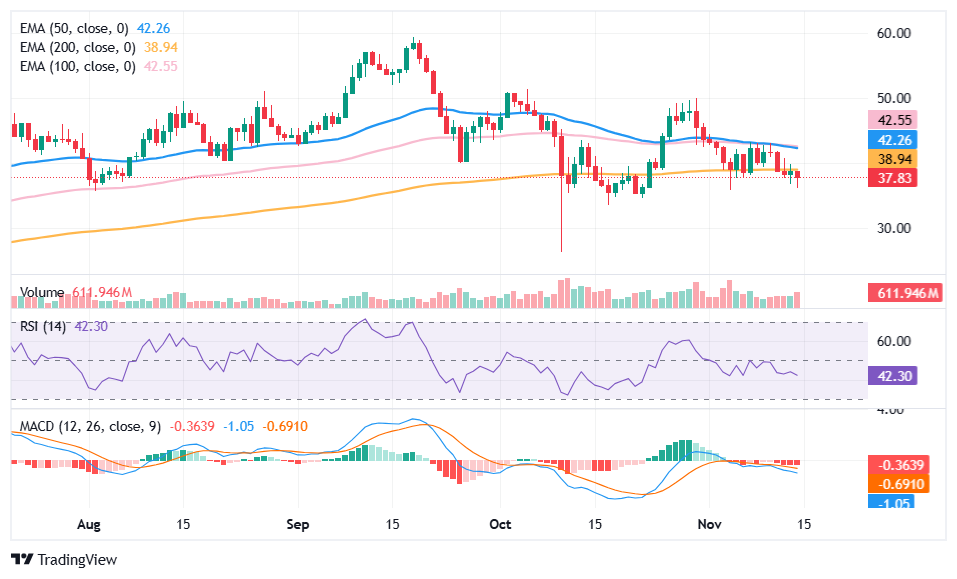
The price of HYPE increased slightly from $37.77 to $39.39 once the attack was resolved, suggesting that retail confidence in the token remained somewhat intact.
However, the token has since retraced to approximately $38.09 at the time of publication, casting a cautious outlook for the longer term.
Technical indicators paint a bearish picture, with HYPE trading below its 200-day exponential moving average at just under $39 and struggling to surpass the 50-day and 100-day EMAs around $43.
 Hyperliquid Price Chart | Source: CoinMarketCap
Momentum indicators, including MACD and RSI, suggest persistent selling pressure, and analysts warn that a decisive break below the support level of $35 could accelerate a decline towards the $30 mark.

Meet William, a proud Bethel University alumnus with a fervent passion for lifestyle and culture topics. His keen interest doesn’t stop there; he’s also deeply engrossed in current events of all kinds. William dedicates himself wholeheartedly to this site, thriving on the collaborative energy he shares with Suzanne, his long-standing partner in crime.
Having navigated their university courses side by side for years, their teamwork on the site is nothing short of dynamic. Together, they bring a unique blend of insights, proving that two heads are indeed better than one in delivering compelling content.