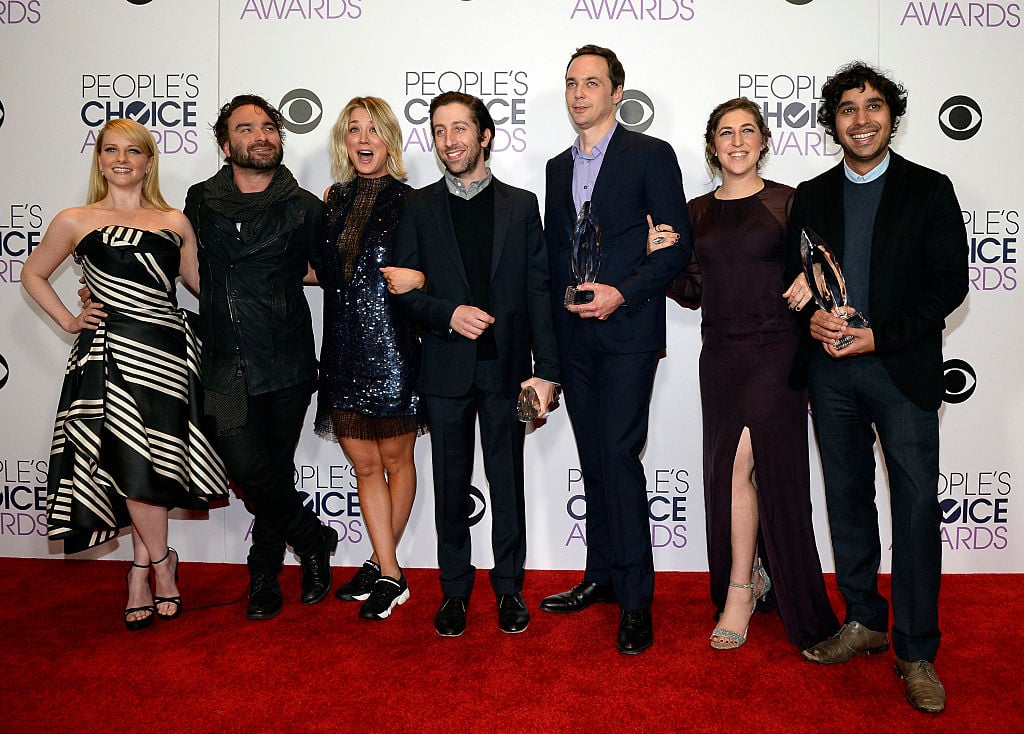
In 2017, “The Big Bang Theory” was not only a beloved sitcom but also a powerhouse in global television syndication, amassing billions in licensing revenue for Warner Bros. Over its decade-long run, it transformed its lead actors into some of the highest-paid figures in television history. However, the financial journey of its cast reveals a more complex story behind the astronomical salary figures.
The Three-Tier Era
When “The Big Bang Theory” premiered in 2007, the pay for its original cast was modest by today’s standards. Jim Parsons, Johnny Galecki, and Kaley Cuoco earned approximately $60,000 per episode, while co-stars Simon Helberg and Kunal Nayyar started at about $45,000 per episode. With 17 episodes in the inaugural season, this translated to roughly $765,000 for the lower earners and just over $1 million for the top three actors.
As the show gained popularity, the pay discrepancies became stark. By Season 4, Parsons, Galecki, and Cuoco successfully renegotiated their contracts, boosting their earnings to $200,000 per episode. This figure climbed further between Seasons 5 and 7, hitting $350,000 per episode, alongside a 0.25% share of the show’s backend profits. At 24 episodes per season, their annual earnings soared: $4.8 million at the $200,000 per episode rate and $8.4 million at $350,000.
In contrast, Helberg and Nayyar experienced raises too, but their salaries only reached the $100,000 to $125,000 per episode range. Although integral to the show’s chemistry, they remained behind financially compared to their counterparts. Additionally, Mayim Bialik and Melissa Rauch, who became series regulars in Season 4, earned significantly less, with salaries estimated between $175,000 and $200,000 per episode.
The $1 Million Club
As the show approached Season 8 in 2014, Parsons, Galecki, and Cuoco negotiated historical contracts, earning $1 million per episode and securing a 1% share of the show’s backend profits, resulting in about $24 million per season each. Helberg and Nayyar, during this negotiation, asserted their worth, resulting in adjustments that also brought them to the million-dollar salary level.
By the mid-2010s, all five original stars were earning a staggering $24 million per season before backend profits. However, Bialik and Rauch remained at approximately $200,000 per episode, representing a significant pay disparity, despite their characters becoming essential to the show’s storylines.
The 2017 Renewal
When “The Big Bang Theory” was renewed for its final two seasons (Seasons 11 and 12), the main cast expected to maintain their $1 million per episode salaries. Bialik and Rauch, no longer in supporting roles, sought to increase their earnings to the $450,000 or more per episode range, but Warner Bros. claimed budget constraints made such raises impossible.
The $100,000 Pay Cut
In a surprising move, the five original stars proposed to voluntarily decrease their salaries by $100,000 per episode, reducing their compensation from $1 million to $900,000. This decision freed up $500,000 per episode, enabling Bialik and Rauch’s salaries to rise to approximately $450,000–$500,000 per episode.
Over the 48 final episodes, the five stars collectively forfeited $24 million in potential earnings, contributing roughly $4.8 million each. Though this did not equalize their pay completely, it notably narrowed the financial gap and represented a rare example of wealth redistribution in network television.
Why This Was So Unusual (and Risky)
The magnitude of this financial gesture is remarkable, especially considering Hollywood’s complex history with salary negotiations. Many actors have faced severe repercussions for seeking pay equity, such as Suzanne Somers, who was famously ousted from “Three’s Company” after demanding a salary raise that her co-star received.
Even in recent years, studios have shown little mercy. The immediate firing of “CSI” stars George Eads and Jorja Fox during a pay dispute highlighted the risks associated with negotiating for substantial raises. Their eventual rehiring came only after public apologies and acceptance of their original salaries, underscoring the precarious nature of Hollywood contracts.

Meet William, a proud Bethel University alumnus with a fervent passion for lifestyle and culture topics. His keen interest doesn’t stop there; he’s also deeply engrossed in current events of all kinds. William dedicates himself wholeheartedly to this site, thriving on the collaborative energy he shares with Suzanne, his long-standing partner in crime.
Having navigated their university courses side by side for years, their teamwork on the site is nothing short of dynamic. Together, they bring a unique blend of insights, proving that two heads are indeed better than one in delivering compelling content.