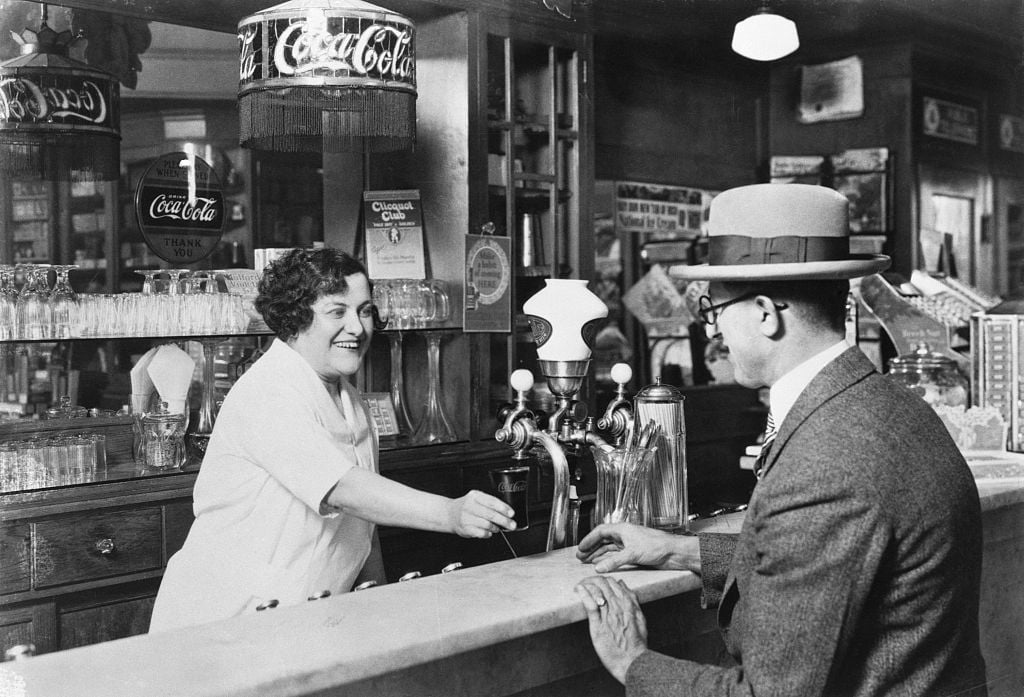
Imagine having a time machine at your disposal—where would you go? While many might consider witnessing significant historical events, what if the real opportunity lies in amassing wealth? In this exploration, we dive into the alluring prospect of investing in stocks from over a century ago, specifically focusing on Coca-Cola’s initial public offering (IPO) as a lucrative choice for time travelers aiming to secure their financial future.
Investing Across Time: The Time Machine Dilemma
If you had a time machine and the chance to travel back at least 100 years, a pressing question arises: what would you purchase? The idea of simply acquiring Bitcoin decades ago may be appealing, but let’s narrow it down to a historical period before 1925. The catch? You must think discreetly about your purchases. Options available back then, such as land, would be impractical—what currency would you use, and how would you manage your assets through the centuries?
Clearly, the ideal investment would need to meet specific criteria: it should be relatively inexpensive, easy to buy anonymously, trackable, and capable of generating generational wealth. Given these stipulations, venturing into the stock market emerges as a commendable choice. If you were to travel back a century with a small amount of money, Coca-Cola would be a prime candidate for your investment.
A Brief History of Coca-Cola: From Conception to IPO
The origins of Coca-Cola trace back to John “Doc” Pemberton, a pharmacist from Georgia who, after the Civil War, began concocting remedies for pain relief. Pemberton’s initial attempts were unsuccessful until he drew inspiration from a popular formula in Europe that combined cocaine and wine. Adapting his recipe, he created “French Wine Coca” but adjusted it after Atlanta imposed temperance laws in 1885. This led to the creation of the non-alcoholic Coca-Cola, the name conceived by his bookkeeper Frank Robinson.
Though the drink quickly gained popularity, Pemberton sold his interest to Asa Candler, who recognized Coca-Cola’s potential. Candler introduced aggressive marketing strategies, making Coca-Cola a national sensation and eliminating any traces of cocaine by 1903. By 1919, Candler sold the company for $25 million, leading to its IPO at a share price of $40.
The Financial Impact of Coca-Cola’s IPO
The impact of Coca-Cola’s IPO was far-reaching. If you had entered the New York Stock Exchange on September 5, 1919, with just $40, the returns would have been astounding over the past century. Since the IPO, Coca-Cola has seen multiple stock splits, meaning that a single share purchased in 1919 has transformed into an astonishing 9,216 shares today, valued at approximately $635,000 based on current stock prices.
However, Coca-Cola’s dividends significantly augment this figure. For instance, in 2024, the company paid out $1.94 per share, translating into around $18,000 for an individual holding 9,216 shares. Those dividends can be reinvested to acquire even more shares, allowing for exponential growth over time. Imagine what could be amassed if this strategy were applied consistently for over a century!
The Power of Dividend Reinvestment
Calculating the astronomical value of those investments can be daunting, yet past data reveals an impressive outcome. In 2012, it was reported that a $40 share purchased in 1919 could grow to $341,545 without reinvestment but skyrocketed to approximately $9.8 million when dividends were reinvested. Updating the figures through the end of 2024 indicates that a single share could now be worth around $25 million with full engagement in the reinvestment program!
To amplify this effect even further, consider the scenario of purchasing 100 shares at the IPO, which would cost you about $4,000 at the time—equivalent to $75,000 today. This investment today boasts over 921,600 shares, yielding more than $1.7 million in dividends annually and resulting in a total worth of roughly $2.5 billion through diligent dividend reinvestment.
The potential to change one’s financial legacy is palpable in this time-travel exercise. Perhaps we should all reconsider our historical focus and instead contemplate the compelling opportunities from the past!

Meet William, a proud Bethel University alumnus with a fervent passion for lifestyle and culture topics. His keen interest doesn’t stop there; he’s also deeply engrossed in current events of all kinds. William dedicates himself wholeheartedly to this site, thriving on the collaborative energy he shares with Suzanne, his long-standing partner in crime.
Having navigated their university courses side by side for years, their teamwork on the site is nothing short of dynamic. Together, they bring a unique blend of insights, proving that two heads are indeed better than one in delivering compelling content.