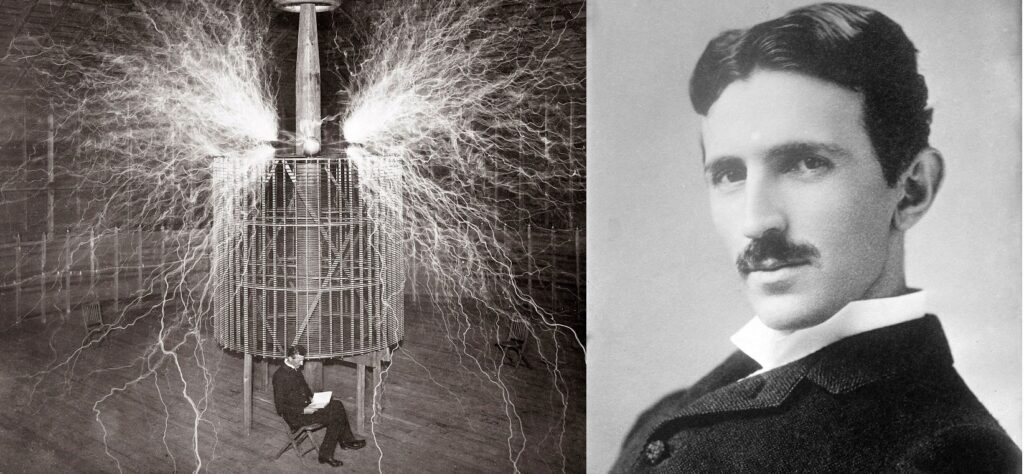
In 1884, Nikola Tesla, a Serbian-born inventor, arrived in America with little more than four cents and a letter of recommendation for Thomas Edison. Their brief collaboration ignited a rivalry that led to revolutionary advancements in electrical engineering. While Tesla’s innovations paved the way for modern power systems, he faced financial ruin due to a series of poor business decisions. This article explores Tesla’s remarkable journey, his feud with Edison, and how his choices impacted his legacy.
The Arrival of Tesla in America
In 1884, Nikola Tesla, then a 28-year-old inventor from Serbia, immigrated to America, arriving at Ellis Island from Paris. Armed with a mere book of poetry and a letter of recommendation addressed to the renowned businessman Thomas Edison, Tesla brought only four cents with him. His initial employment at Edison General Electric promised a weekly salary of $18 and an opportunity for a $50,000 bonus (equivalent to over $1 million today) for significantly improving Edison’s Direct Current (DC) electrical motor system. Within two months, Tesla achieved this feat, but Edison dismissed the bonus as a joke, offering instead a mere $10 raise. Disillusioned, Tesla left the job the same day.
Subsequently, Tesla founded the Tesla Electric Light & Manufacturing Company, but this venture failed, forcing him to take up manual labor to make ends meet.
Alternating Current vs. Direct Current
By the late 1800s, electricity was still a luxury; no homes had it prior to 1880. Thomas Edison pioneered the use of Direct Current (DC) electricity, establishing himself as a wealthy entrepreneur with Edison General Electric. However, DC was limited; it could only service a few homes within a short radius of power sources.
In April 1887, Tesla started the Tesla Electric Company and patented his groundbreaking Brushless Alternating Current (AC) Motor. This new AC system proved vastly superior, offering higher voltages and the ability to transmit electricity over long distances—up to 1,000 times cheaper than the DC system. Today, homes in America predominantly use AC, while DC remains relegated to certain applications like batteries.
Tesla’s Financial Triumphs and Setbacks
As Tesla’s innovations gained recognition, Westinghouse Electric & Manufacturing Company approached him in 1888, offering to license his AC patents for $60,000, shares in the company, and a monthly salary of $2,000. By 1890, Tesla had become a millionaire as AC power gained popularity, with royalties accumulating to hundreds of thousands of dollars annually.
However, Tesla’s relationship with Westinghouse soon became strained, particularly during the “War of Currents,” where Edison waged a smear campaign against AC technology, employing shocking public demonstrations to promote DC’s safety. Despite the financial strain on Westinghouse, Tesla chose to rescind his royalty payments to help the company survive, an act of loyalty that ultimately cost him his financial prospects.
The Downfall of a Visionary
By 1907, Tesla’s patents were valued at $12 million (comparable to over $300 million today). The decision to forgo royalties proved financially disastrous, as AC technology gained worldwide adoption, making Tesla a potential billionaire who never realized that fortune. Over the next few decades, Tesla faced numerous business failures, and by the time of his death in 1943, he was bankrupt, living in solitude in a New York hotel.
Despite the struggles he faced in life, Tesla’s legacy endures through the innovations of contemporary tech giants like Google founders Larry Page and Sergey Brin, who have expressed admiration for his accomplishments. Additionally, he is honored in his native Serbia, where the Nikola Tesla Airport bears his name, and his image appears on currency.
Ironically, the “War of Currents” also led to Edison’s downfall. His company accumulated significant debt and eventually fell under the complete control of financier J.P. Morgan, merging with Thomson-Houston Electric Company to become General Electric, which remains a major player in the industry today.

Meet William, a proud Bethel University alumnus with a fervent passion for lifestyle and culture topics. His keen interest doesn’t stop there; he’s also deeply engrossed in current events of all kinds. William dedicates himself wholeheartedly to this site, thriving on the collaborative energy he shares with Suzanne, his long-standing partner in crime.
Having navigated their university courses side by side for years, their teamwork on the site is nothing short of dynamic. Together, they bring a unique blend of insights, proving that two heads are indeed better than one in delivering compelling content.