In the mid-1980s, Benjamin Sisti found himself at the pinnacle of success as the head of Colonial Realty, a prominent real estate firm. However, his opulent lifestyle was built on a facade of deceit that would ultimately lead to one of the largest frauds in Connecticut’s history. The tale of Sisti’s luxurious mansion and the subsequent owners, including boxing champion Mike Tyson and rapper 50 Cent, reflects a dramatic shift from prosperity to financial ruin.
A Mansion Is Born
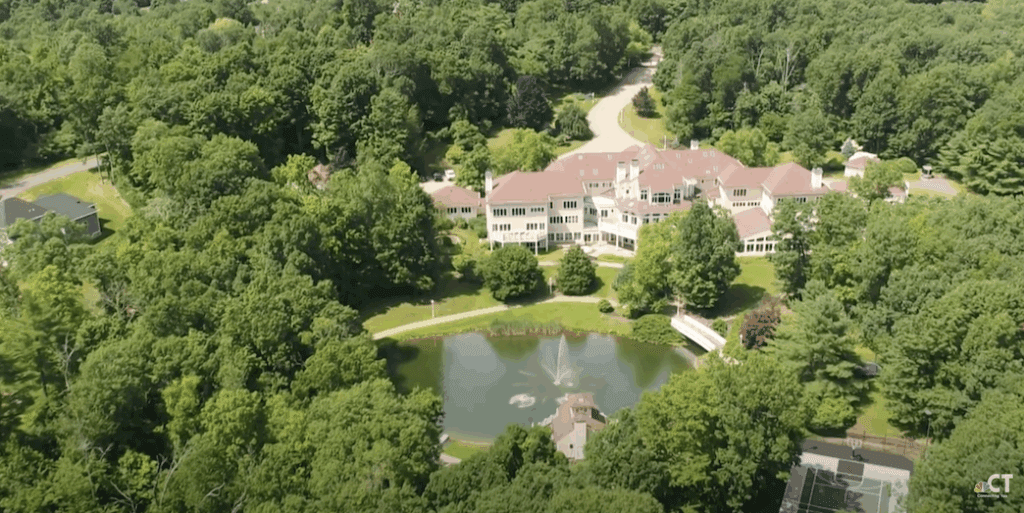
In 1985, as a testament to his booming success, Sisti completed a stunning 52,000-square-foot mansion situated on over 17 acres in Farmington, Connecticut, just a short drive from Colonial’s Hartford headquarters. The mansion, which cost an estimated $2.3 million to build—equivalent to about $7 million today—boasts an impressive private lake, a tennis court, a four-bedroom guest house, and a primary home featuring around 20 bedrooms and 40 bathrooms.
However, beneath this lavish exterior lay a web of deception. Sisti was orchestrating a massive Ponzi-like scheme through Colonial Realty, misappropriating funds from investors while hiding the company’s financial collapse. He concealed crucial information and funneled millions to relatives to protect assets from creditors. Allegations included bribing public officials to secure ongoing pension investments into their projects, impacting an estimated 7,000 victims, many of whom reportedly lost their life savings. This scandal still stands as the largest real estate fraud in Connecticut’s history.
By 1990, Sisti and Colonial Realty were forced into bankruptcy. In his filing, Sisti claimed to possess a mere $15,000 in cash. The mansion fell into foreclosure, with People’s Bank acquiring it at auction in 1992 for $3.5 million. A year later, Sisti accepted a plea deal and was sentenced to nine years in federal prison.
Meanwhile, in 1993, a Lithuanian businessman purchased the mansion from the bank for $2.7 million, but faced financial troubles of his own. He eventually sold the estate to boxing legend Mike Tyson in early 1996 for $2.8 million.
The Mike Tyson Era
Before buying the mansion, Tyson was serving a prison sentence for a 1992 rape conviction but was released in March 1995. Just six months later, he made a spectacular comeback in the boxing ring, earning $25 million in one fight. This victory was a harbinger of even greater wealth, as Tyson accrued $155 million from just six fights over the subsequent two years and invested a substantial portion of it into the Connecticut estate. He transformed the mansion by adding amenities such as a nightclub dubbed “Club TKO,” an indoor pool, a basketball court, and a racquetball court.
However, Tyson’s extravagant lifestyle soon led to financial turmoil. In his first three years post-release, his spending included:
- $4.5 million on cars and motorbikes (including 19 vehicles for friends)
- $400,000 on exotic pets including pigeons and big cats
- $300,000 on lawn care
- $240,000 monthly as ‘walking-around money’
- $230,000 on cell phones and accessories
- $125,000 annually for pet care
- $100,000 monthly on jewelry and clothing
Tyson attempted to sell the mansion in May 1997 for $22 million, significantly more than he had paid. However, there were no buyers. In August 2003, he filed for Chapter 11 bankruptcy, listing $5 million in assets against $27 million in debt. As part of his divorce settlement with Monica Turner, she received the Connecticut mansion, which she quickly sold for $4.1 million.
50 Cent Takes Over
In early 2003, rapper 50 Cent gained massive popularity with his hit single “In Da Club” and his album “Get Rich or Die Trying,” selling 12 million copies worldwide. He purchased the mansion from Monica Turner and proceeded to invest further, adding features such as a movie theater, pool grotto, and a helipad. In 2007, he showcased his lifestyle on MTV’s “Cribs,” presenting an impressive car collection that reportedly included high-end Ferraris.
However, doubts have emerged regarding the ownership of some of these vehicles, with claims suggesting they may have belonged to a neighboring collector. Despite the controversies surrounding his car collection, 50 Cent listed the estate in 2007 for $18.5 million, but found no buyers. Over the following years, he tried to sell it for nearly $10 million but faced mounting financial challenges.
In July 2015, 50 Cent filed for bankruptcy, listing $36 million in debts and $16 million in assets. He indicated that maintaining the Connecticut mansion cost him almost $70,000 monthly. Ultimately, he sold the property in April 2019 for $2.9 million.
2019 – The Present
The buyer in 2019 was Casey Askar, a businessman from Florida who made his fortune with fast-food franchises, including multiple Dunkin’ Donuts locations. Recently, the Askars have listed the mansion for sale at $9.90 million. Appearing to be on stable financial ground, they have provided tours of the home, indicating that the renovated estate may have finally shaken off its troubled past.
Note: The Askar family shared a tour of the mansion shortly after their purchase, highlighting its luxurious features.

Meet William, a proud Bethel University alumnus with a fervent passion for lifestyle and culture topics. His keen interest doesn’t stop there; he’s also deeply engrossed in current events of all kinds. William dedicates himself wholeheartedly to this site, thriving on the collaborative energy he shares with Suzanne, his long-standing partner in crime.
Having navigated their university courses side by side for years, their teamwork on the site is nothing short of dynamic. Together, they bring a unique blend of insights, proving that two heads are indeed better than one in delivering compelling content.