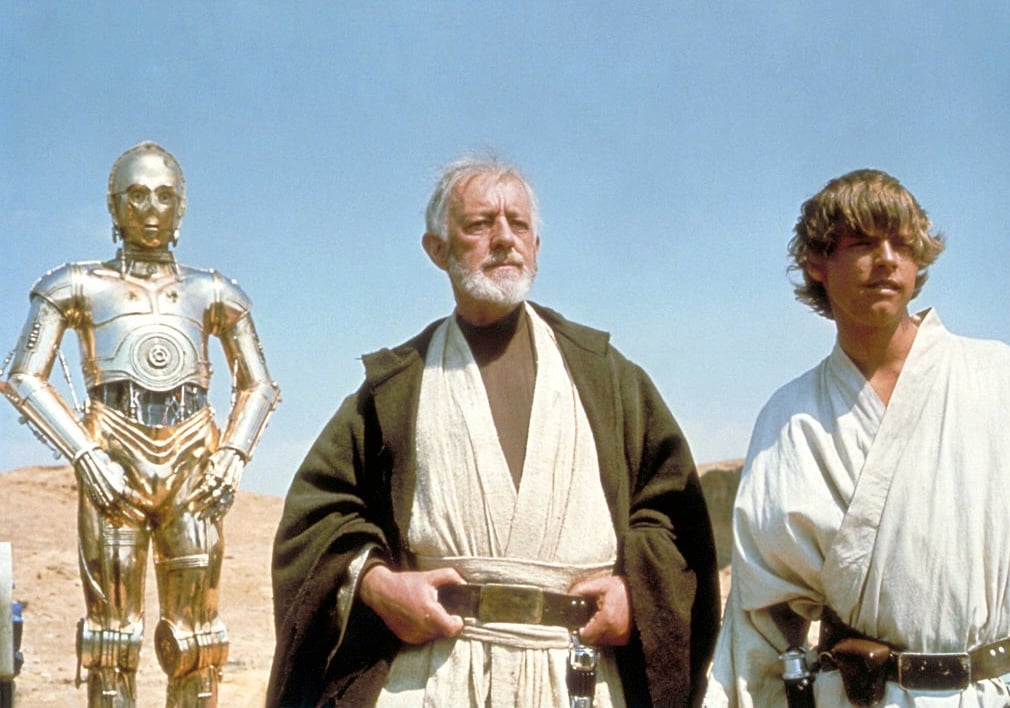
In a remarkable turn of events, one of cinema’s most iconic roles stemmed from a last-minute decision by a legendary actor. Alec Guinness, previously skeptical about a quirky space film directed by George Lucas, ended up striking a deal that not only defined his legacy but also reshaped Hollywood’s approach to actor compensation. This was just the beginning of an extraordinary tale involving “Star Wars,” its surprising box office success, and the lucrative contracts that followed.
The Reluctant Icon
In 1976, the film industry was introduced to a budding director named George Lucas and his ambitious project, “Star Wars.” Sir Alec Guinness, a celebrated actor already renowned for his role in “The Bridge on the River Kwai,” found himself torn when offered a part in this untested venture. After reading the script, which he dismissed as “clunky fairy tale rubbish,” Guinness expressed doubts about its potential. Despite his reservations, he was drawn to the project, especially with a salary of $150,000—which equates to roughly $850,000 today—being offered for just 20 minutes of screen time.
A Bold Negotiation
Alec Guinness, however, wasn’t just looking for a handsome paycheck. Aware of his standing in the industry, he wanted a cut of the film’s profits. His agent approached Lucas and 20th Century Fox with a bold proposal for backend points, meaning a percentage of the film’s gross revenue. At the time, this was a rare arrangement for an actor in his position, particularly for a project that many viewed with skepticism. Nevertheless, Fox agreed, and Guinness secured 2.25% of the box office earnings, while Lucas added an extra 0.25% from his own share.
Initially, many, including Guinness himself, thought the film might only yield modest earnings. The actor even joked in his diary about taking the role out of necessity more than enthusiasm. What he could not anticipate was that this negotiation would go down as one of the most astute financial decisions in Hollywood history.
Box Office Success
“Star Wars” debuted on May 25, 1977, in just 32 theaters but quickly became a cultural phenomenon, grossing over $300 million during its initial release and setting box office records. Guinness’s reaction, captured in his diary, shifted from skepticism to optimism as the film’s success unfolded.
His 2.25% stake yielded more than $7 million from the first run alone, equivalent to around $33 million today. This lucrative return was remarkable for an actor who initially viewed the project as beneath him.
A Lifetime of Earnings
The brilliance of Guinness’s contract didn’t stop with the first film. His cut applied to every subsequent release and re-release, generating ongoing royalties. When “The Empire Strikes Back” was produced in 1980, Guinness returned for a brief appearance, but his financial fortune was already secured by his original deal.
Every revival of “Star Wars” brought in new checks for Guinness, with earnings from merchandise sales adding to his wealth. By the time he passed away in 2000, his lifetime earnings from “Star Wars” were estimated at around $100 million, a figure that has likely grown to approximately $150 million for his estate due to the franchise’s continued success.
Lessons from a Financial Regret
In sharp contrast to Guinness’s success, James Earl Jones, the voice of Darth Vader, rejected a similar points offer early in the production of “Star Wars.” Struggling financially, Jones opted for a flat fee of $7,000—about $33,000 today. While this sum was significant for him at the time, it highlights a missed opportunity, as his decision to forgo backend points exemplifies the risks of prioritizing immediate compensation over long-term benefits.
The Ripple Effect in Hollywood
The deal struck by Alec Guinness has since become a benchmark in Hollywood negotiations. It paved the way for other actors, such as Jack Nicholson and Robert Downey Jr., to secure lucrative backend profits, turning what was once a rarity into a standard expectation among A-list talent. What started as a reluctant role for Guinness transformed into a remarkable legacy of wealth and influence within the film industry.
Conclusion
In retrospect, Guinness’s decision to take a chance on “Star Wars,” despite his initial hesitation, proved transformative. While the role of Obi-Wan Kenobi became indelibly linked to his identity, it also secured him one of the most profitable contracts in film history. Ultimately, this narrative serves as an inspiring lesson in the value of negotiation and foresight in the ever-evolving landscape of Hollywood.

Meet William, a proud Bethel University alumnus with a fervent passion for lifestyle and culture topics. His keen interest doesn’t stop there; he’s also deeply engrossed in current events of all kinds. William dedicates himself wholeheartedly to this site, thriving on the collaborative energy he shares with Suzanne, his long-standing partner in crime.
Having navigated their university courses side by side for years, their teamwork on the site is nothing short of dynamic. Together, they bring a unique blend of insights, proving that two heads are indeed better than one in delivering compelling content.