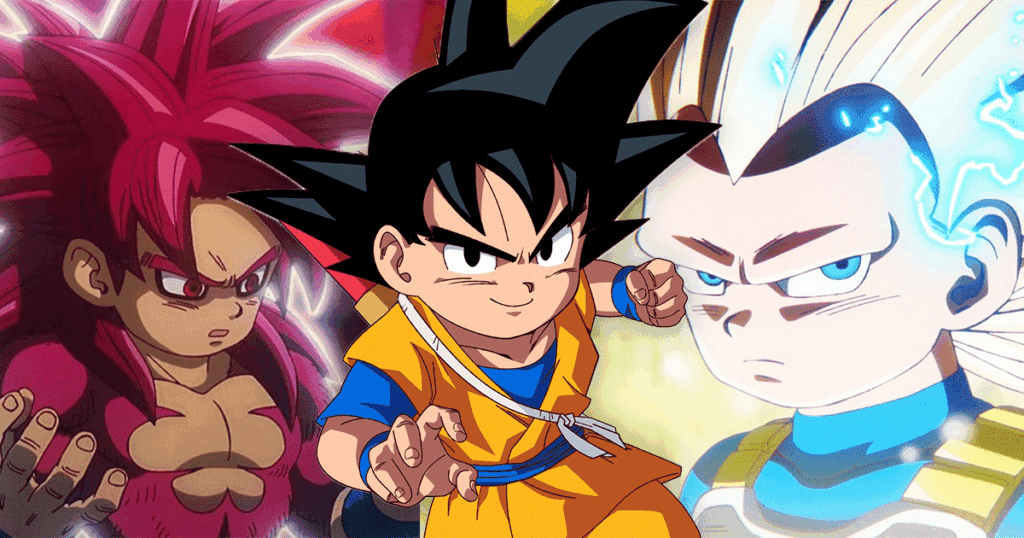
Celebrating the 40th anniversary of Akira Toriyama’s beloved manga series, Dragon Ball Daima was expected to fill the narrative gap between Dragon Ball Z and Dragon Ball Super. However, fans were met with an ending that many found rushed and disappointing. The underlying issue? A production rushed and riddled with improvisation rather than careful planning.
Fans Disappointed by the Conclusion
Behind the scenes, the creative team has gradually shed light on the production challenges faced during the making of Daima. During the Blu-ray release in Japan, producer Akio Iyoku confirmed what many had suspected: the story was not finalized when the anime launched. “In reality, the story was not complete from the start of production,” he admitted. Alarmingly, the team only had half of the script completed, covering just the first nine or ten episodes, before receiving the remaining scripts along the way.
This led to a high-pressure production environment, where each episode introduced surprises, even for those involved in creating it. “We worked with a bit of nervousness and suspense,” Iyoku recalled, adding with a hint of humor, “Honestly, I didn’t think the story would take this direction…” An elegant way of expressing that even the producers were caught off guard by the twists imagined by Toriyama.
Production Challenges and Mixed Results
The conclusion of Daima, however, sparked the most frustration. Iyoku revealed that the finale underwent multiple revisions, as the team desperately sought the “best sequence” and “best content.” “For this part of the story, we changed a lot of things,” he acknowledged, admitting that the final result diverged significantly from the initial plan.
This acknowledgment highlights the considerable challenges they encountered: how can one wrap up a series when the script evolves in real-time? How can they achieve a satisfying conclusion when each episode presents new uncertainties? Ultimately, Dragon Ball Daima showcased a bold, yet risky experiment—an anime written on-the-fly, with its inherent strengths and weaknesses.
Despite its flaws, Daima holds a special place in the franchise. It is, after all, the last story penned by Toriyama, acting as a narrative bridge between two significant eras of the series. However, the lack of rigorous planning leaves a sense of incompleteness, as if the team was racing against its own storyline. For fans, the lesson is clear: while improvisation can sometimes save a scene, it doesn’t always lead to a satisfactory ending. Dragon Ball Daima stands as a testament to this reality.

Meet William, a proud Bethel University alumnus with a fervent passion for lifestyle and culture topics. His keen interest doesn’t stop there; he’s also deeply engrossed in current events of all kinds. William dedicates himself wholeheartedly to this site, thriving on the collaborative energy he shares with Suzanne, his long-standing partner in crime.
Having navigated their university courses side by side for years, their teamwork on the site is nothing short of dynamic. Together, they bring a unique blend of insights, proving that two heads are indeed better than one in delivering compelling content.