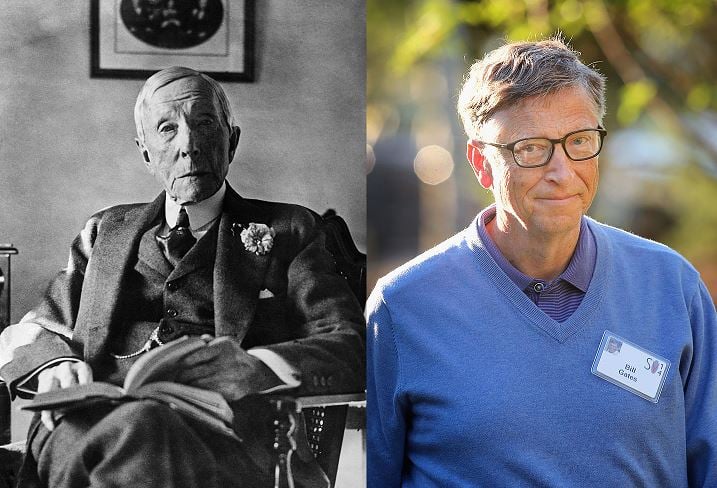
The American pursuit of wealth has historical roots that transcend simple economic ambition. From the nation’s inception, the drive for private wealth has been interwoven into the fabric of its identity. This article explores the richest Americans of all time, measuring their fortunes against inflation and analyzing their lasting impact on the economy.
The Foundation of Wealth in America
High school history educators might gloss over the blunt truth, but the United States was built on the principle that individuals have the right to accumulate vast wealth. This wealth isn’t just a matter of small comforts but extends to fortunes so significant they prompted concerns across the ocean in England. While the Declaration of Independence champions ideals like equality and the pursuit of happiness, the motivating force behind American independence largely stemmed from entrepreneurs frustrated with taxation imposed by the British crown.
No nation has ever been established with such a pronounced focus on material gain. The tenets of capitalism and the right to earn income—unfettered by governmental or ecclesiastical constraints—are deeply embedded in the nation’s founding documents and societal values.
Although modern Americans pay taxes, it’s essential to note that the Internal Revenue Service (IRS) was not created until 1862, and property taxes began only in 1913 with the ratification of the 16th Amendment. The question persists: why do property owners pay an annual fee on assets they have already purchased? While public services like police and roads necessitate funding, these tax structures were not part of the original American framework.
This unique economic foundation is a key reason the United States remains the wealthiest nation globally. The American Dream continues to draw individuals from around the world, each seeking the opportunity to accumulate personal wealth. Remarkably, 15 of the 20 richest individuals today are American, with figures like Mark Zuckerberg and Elon Musk leading the charge.
The Richest Americans of All Time
#10: John Jacob Astor – $180 billion
John Jacob Astor emerged as America’s first multimillionaire, initially amassing his wealth through the fur trade. He later transformed his fortune into real estate acquisitions in New York City, including land that would become the Waldorf Astoria hotel. By the time of his death in 1848, his wealth equated to approximately $180 billion today.
#9: Mark Zuckerberg – $227 billion
Mark Zuckerberg launched Facebook from his Harvard dormitory in 2004. Over the years, the platform evolved into an AI and social media giant. Amid extreme fluctuations, his net worth peaked at $227 billion during the tech boom in 2025, positioning him as a modern-day titan of industry.
#8: Jeff Bezos – $259 billion
As the founder of Amazon, Jeff Bezos revolutionized retail worldwide, growing a garage startup into a $3 trillion enterprise. He first claimed the title of the world’s richest person in 2017. Had his personal circumstances not included a divorce, his wealth could easily exceed $400 billion today.
#7: Sergey Brin – $267 billion
Sergey Brin, originally from Russia, co-created Google alongside Larry Page during their time at Stanford. As the company’s value surged in tandem with innovations in AI, Brin’s wealth reached an impressive $267 billion by 2026.
#6: Cornelius Vanderbilt – $275 billion
Known as “The Commodore,” Cornelius Vanderbilt began his career in steamboats and later invested in railroads, resulting in tremendous wealth at the age of 70. He established Vanderbilt University, and at the time of his death in 1877, his fortune was equivalent to $275 billion today.
#5: Larry Page – $287 billion
As a co-founder of Google, Larry Page holds a slightly larger stake than his partner Brin, which places him fifth on the all-time wealth list. His peak wealth reached $287 billion, underscoring the company’s status as a dominant player in technology.
#4: Larry Ellison – $393 billion
Ellison saw his wealth surge during an AI boom in late 2025, pushing his net worth to an unprecedented $393 billion. This remarkable growth made him the wealthiest software mogul in history.
#3: Andrew Carnegie – $460 billion
Carnegie became a towering figure in the steel industry, eventually selling his company to J.P. Morgan in 1901 for $480 million. By the height of his wealth, he was worth around $460 billion in today’s dollars and dedicated much of his fortune to philanthropy.
#2: John D. Rockefeller – $500 billion
John D. Rockefeller, founder of Standard Oil, was for many years the wealthiest American. Controlling 90% of U.S. oil, his fortune exploded following the breakup of his monopoly. Adjusted for inflation, his wealth peaked at $500 billion, making him the first individual to ever reach a billion-dollar net worth.
#1: Elon Musk – $750 billion
Presently, Elon Musk tops the list as the wealthiest American in history. By early 2026, the combined valuations of Tesla and SpaceX elevated his net worth to an extraordinary $750 billion, accounting for 2.5% of the U.S. GDP, surpassing even Rockefeller’s peak percentage.
Considerations on Wealth Dynamics
While the rankings of wealth are telling, there are significant caveats to consider:
- What if Jeff Bezos had not divorced?
- What if Warren Buffett had not donated any of his wealth?
- What if Bill Gates had similarly refrained from philanthropy and divorce?
In 2019, Bezos transferred approximately 25% of his Amazon shares to MacKenzie Scott. If he hadn’t lost that stake, he could currently be worth around $400 billion. Warren Buffett’s giving has cost him significantly, as he began donating Berkshire Hathaway shares in 2006. Had he retained his original stake, his net worth could also be around $400 billion today. Likewise, Bill Gates’ fortunes took a hit due to his charitable donations and divorce, possibly worth $315 billion under different circumstances.
The Final Conclusion
For nearly a century, John D. Rockefeller served as the benchmark for wealth in America. However, with Elon Musk’s status as of January 2026, wealth accumulation has reached unprecedented levels, with Musk’s $750 billion representing 2.5% of the total U.S. economy. As we navigate this era of wealth generation, the looming question remains: When will we witness the emergence of the world’s first trillionaire?

Meet William, a proud Bethel University alumnus with a fervent passion for lifestyle and culture topics. His keen interest doesn’t stop there; he’s also deeply engrossed in current events of all kinds. William dedicates himself wholeheartedly to this site, thriving on the collaborative energy he shares with Suzanne, his long-standing partner in crime.
Having navigated their university courses side by side for years, their teamwork on the site is nothing short of dynamic. Together, they bring a unique blend of insights, proving that two heads are indeed better than one in delivering compelling content.