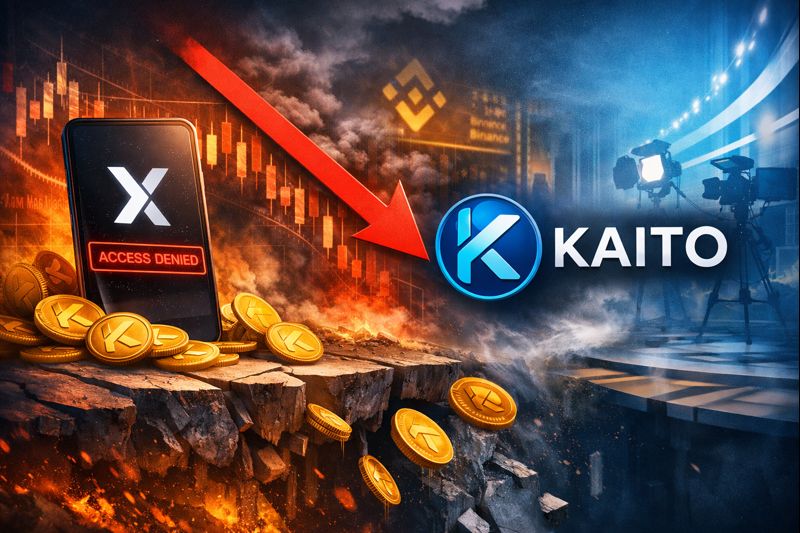
Kaito has initiated the shutdown of its Yaps product following the loss of access to the X API, a significant shift that impacts the overall project and its token economy. This decision comes in light of a policy change by X, formerly known as Twitter, which has prohibited applications that reward users for posting content on the platform.
Impact of X’s Policy Change on Kaito
The Yaps feature was Kaito’s flagship offering and served as the primary engagement driver within its ecosystem. The program incentivized users with KAITO tokens for creating and interacting with crypto-related content on X. For many participants, Yaps was a key reason to hold and utilize KAITO tokens. Industry estimates suggest that Yaps accounted for approximately 70% of the actual utility of KAITO tokens.
The discontinuation of Yaps has triggered an immediate and severe demand shock for the token. Kaito confirmed that the Yaps incentive program and its associated rankings would be fully removed rather than modified, stating that the product could not operate under the new API restrictions imposed by X. This sudden exit has illuminated the risks of building token engagement models on centralized social media platforms. Thousands of users were affected by this change almost overnight, with market trackers reporting around 157,000 Yap-associated accounts that were banned or disabled following the policy enforcement.
The abrupt user loss has intensified sell pressure as participants exited positions tied to the discontinued program.
Market Reaction and Insider Trading Concerns
Market response to the shutdown of Yaps was swift and decisive. KAITO dropped by 19.5% within 24 hours, significantly underperforming against the broader cryptocurrency market, which declined only 1.05% during the same timeframe. The token fell to approximately $0.5449, nearing its historical low of $0.4717 recorded in December. Trading volume surged to over $153 million in 24 hours, exceeding the project’s daily market capitalization.
This spike in volume indicated sales driven by despair rather than temporary volatility. Sentiment further worsened as allegations of insider trading began circulating within the crypto community. On-chain analysts reported that a wallet linked to the Kaito team had deposited 5 million KAITO tokens—valued at about $2.7 million at the time—on Binance. This transfer occurred roughly a week before the public announcement of Yaps’ closure, representing almost 2% of the circulating supply and marking the largest exchange inflow for KAITO in the past 90 days.
While no wrongdoing has been proven, the timing of the deposit raised concerns about information asymmetry. Retail investors interpreted this move as a potential sign of dwindling insider confidence, exacerbating the downward pressure already created by the token’s utility loss. Meanwhile, Kaito is attempting to reposition its business model, announcing a pivot to Kaito Studio, a product focused on connecting brands with creators. Unlike Yaps, this new model emphasizes quality-driven marketing and analytics rather than massive token creation incentives.
KAIOT Price Analysis and Ecosystem Transition
From a technical perspective, KAITO has confirmed a bearish breakout, falling below the critical support level of $0.60, previously a psychological and structural floor. Momentum indicators have turned decidedly negative, with the MACD histogram shifting toward a bearish trend, while the RSI hovers around 44, suggesting that further declines are possible.
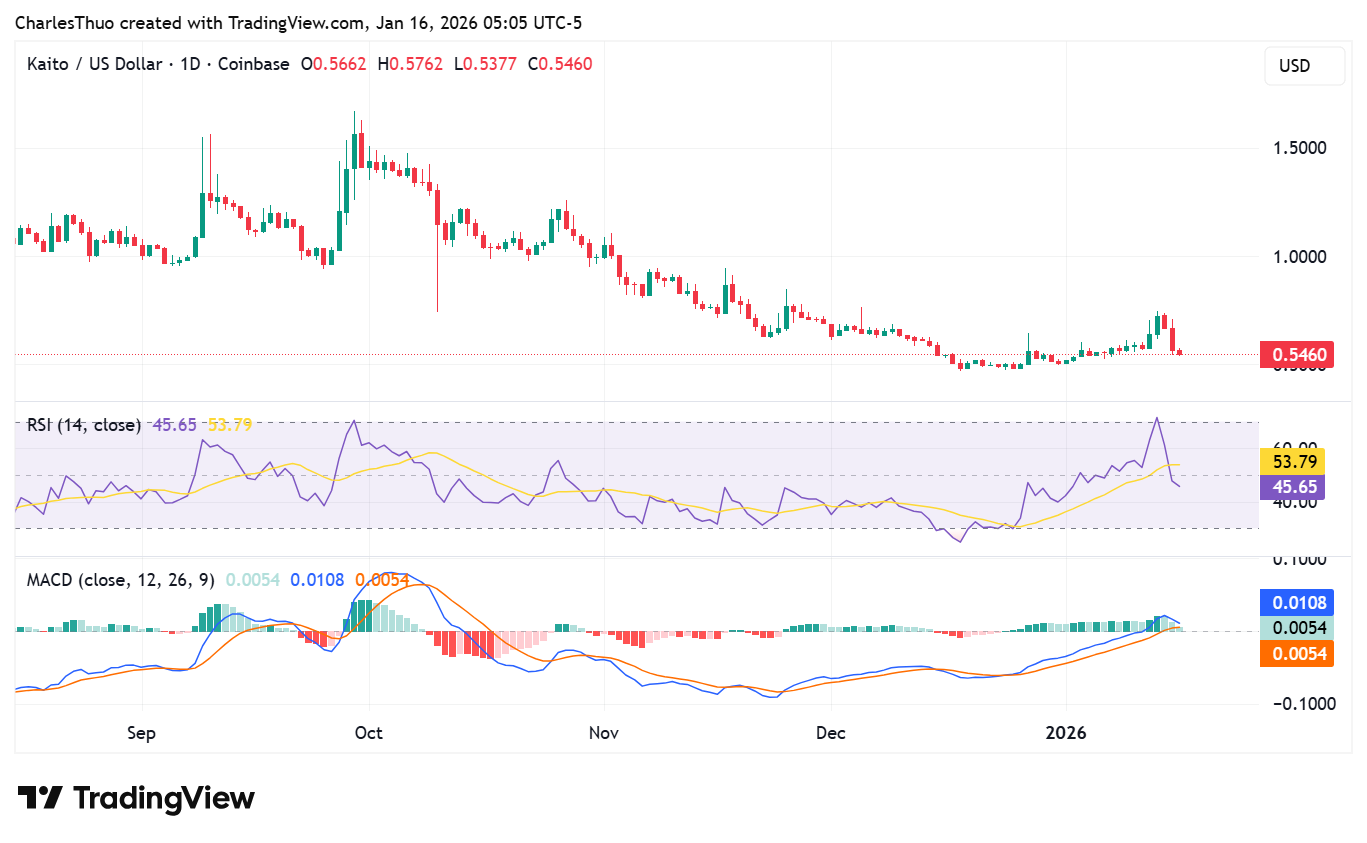
Algorithmic trading systems appear to have accelerated selling following the loss of the $0.60 support level. With limited historical support below current levels, the next significant technical target lies around $0.47.
Future Price Predictions for Kaito
KAITO is currently trading at approximately $0.5449 with a market capitalization near $131 million and a fully diluted valuation of about $540 million. The considerable gap between circulating and total supply highlights a persistent dilution risk. In the short term, price action remains fragile as long as KAITO trades below the resistance zone of $0.60. A failure to maintain above $0.50 could open the door for a further test of the historical low of $0.47.
Any relief rally is expected to face significant selling pressure from holders trapped near previous support levels. An upward reversal would require a sustained reclaim of $0.60 accompanied by reduced sell volume. Fundamentally, clarity regarding internal wallet activities and transparent communication from the team are crucial. The long-term growth potential depends on Kaito Studio’s ability to generate meaningful demand directly involving the KAITO token. Until this narrative is proven, KAITO risks remaining volatile and sentiment-driven. For now, the market appears to favor caution over confidence.

Meet William, a proud Bethel University alumnus with a fervent passion for lifestyle and culture topics. His keen interest doesn’t stop there; he’s also deeply engrossed in current events of all kinds. William dedicates himself wholeheartedly to this site, thriving on the collaborative energy he shares with Suzanne, his long-standing partner in crime.
Having navigated their university courses side by side for years, their teamwork on the site is nothing short of dynamic. Together, they bring a unique blend of insights, proving that two heads are indeed better than one in delivering compelling content.